Should I Be Worried About Feet Turning In/Out While Walking?
“Turning both feet in or out during walking – is that okay?”
Short answer – usually yes- but it depends!
Long answer – let’s dig into the ‘it depends’…because it is VERY common to see children turning feet inwards or outwards, especially when learning to walk & developing strength & muscular control. And while it is often not a major concern and something they generally work through on their own as they get stronger, there ARE times where it is worth investigating to ensure there is nothing that should be assessed or addressed – so let’s talk about it!
First, some basic definitions:
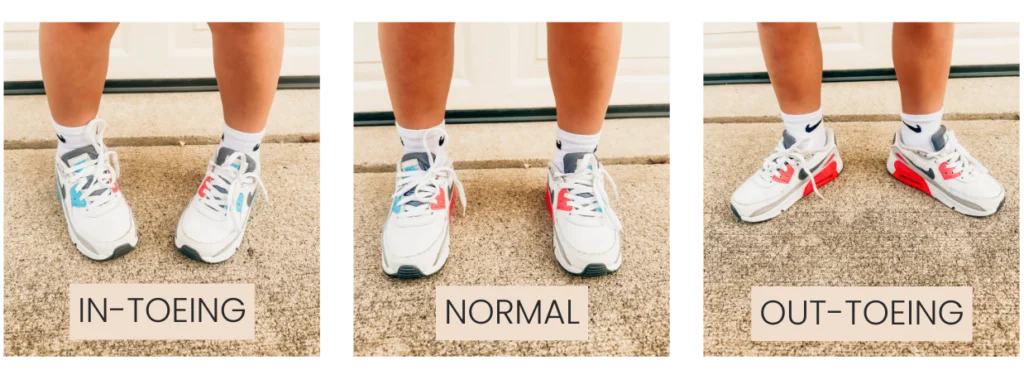
- In-toeing: also referred to as ‘pigeon toed’, is when a child walks with their toes turned inwards toward each other to varying degrees.
- Out-toeing: sometimes referred to as ‘duck walking’, refers to when toes point outwards when walking.
In general – babies are born with legs flexed up due to in utero positioning. As they move through tummy time and early milestones like rolling, crawling, and sitting, the legs gradually begin to move through their own developmental progression – slowly moving away from their newborn ‘froggie’ position towards straightening & strengthening into what we consider ‘normal’ to allow us to move through upright skills like pulling to stand on furniture, cruising and eventually those exciting first steps!
Now…let’s dig into in-toeing a bit more, because it is definitely more common to see.
What are common causes of in-toeing?
Though there can be many contributing factors, including certain diagnoses and neurological conditions, the assessment of in-toeing to determine where it is originating from typically includes assessment of hips, lower leg, and feet, including the strength and range of motion available in major muscle groups.
While assessing whether in-toeing is originating from the hips, we are looking at the amount of femoral anteversion present, which is an inward torsion of the hips naturally present in children that becomes more neutral as their musculoskeletal system matures and they become stronger, typically occurring by the age of 10. However, if there is MORE femoral anteversion present than we expect, it can contribute to a pigeon toed leg alignment during walking and may require skilled assessment and intervention to prevent injuries, pain & compensations.
For the lower leg, assessment of the amount of tibial torsion present is also important. If there is MORE internal tibial torsion than expected, in-toeing will be present during walking.
Finally, assessing the feet is important in determining the origin of pigeon toeing. Specifically, assessing for a condition called metatarsus adductus, which is when the mid foot and toes point inward, which gives the appearance of in-toeing. Though this can (and often does!) self correct, skilled assessment and intervention is important in certain situations to help prevent pain, injuries & improve function long term!
What are common causes of out-toeing?
Basically….The same areas as in-toeing can be involved, but in reverse!
*Common* causes of out-toeing include:
- Shin bone torsion (external tibial torsion)
- Foot alignment (especially when flat feet & collapsed arches are present) *flat feet are usually the most common reason for out-toeing in children.
- Weakness or tightness in certain muscle groups
Less common causes of out-toeing:
- Femoral (thigh bone) retroversion – which is an outward torsion/twist of the hips, typically present in conjunction with the pelvis being tipped more forward (anteriorly)
- Slipped Capital Femoral Epiphysis (SCFE) – which is a serious condition impacting the hip joint, most often during adolescence. SCFE typically presents with pain, a limp during walking, and limitations in range of motion at the hip and requires surgical intervention to stabilize the hip.
- *If in-toeing OR out-toeing is associated with pain, limping, or a history of hip dysplasia or concerns around hip development, it is VERY important to make your healthcare provider aware as soon as possible.
How do I know if I should have my child seen related to in-toeing?
lways, always bring any concerns you have regarding your child’s development to their care team so they can perform an individualized assessment and determine if referral to an orthopedist is warranted.
However, there are some fairly ‘easy’ ways to get a general idea of not only the origin of the in-toeing, but whether pushing for a referral is necessary – so let’s talk about it!
First, consider your little ones age.
Generally speaking, in-toeing UNDER 12-18 months of age is MOST OFTEN related to the foot (metatarsus adductus), and can even often be related to their foot positioning when they were in utero.
For children between 1-3 years of age, the shin bone/tibial torsion are often the origin of in-toeing.
And for children with in-toeing present beyond 4-5 years old, the hip/femoral anteversion are often the origin.
Another quick tip for teasing out where the origin may be is by watching your child walk while standing IN FRONT of them.
- If their knees dive inward toward each other while standing & walking, it is often their HIP alignment contributing to the in-toeing.
- In contrast, if their knees remain pointed forward with feet turned inward, you can assume it is likely either their SHIN or FOOT alignment contributing to the in-toeing, NOT the hips.
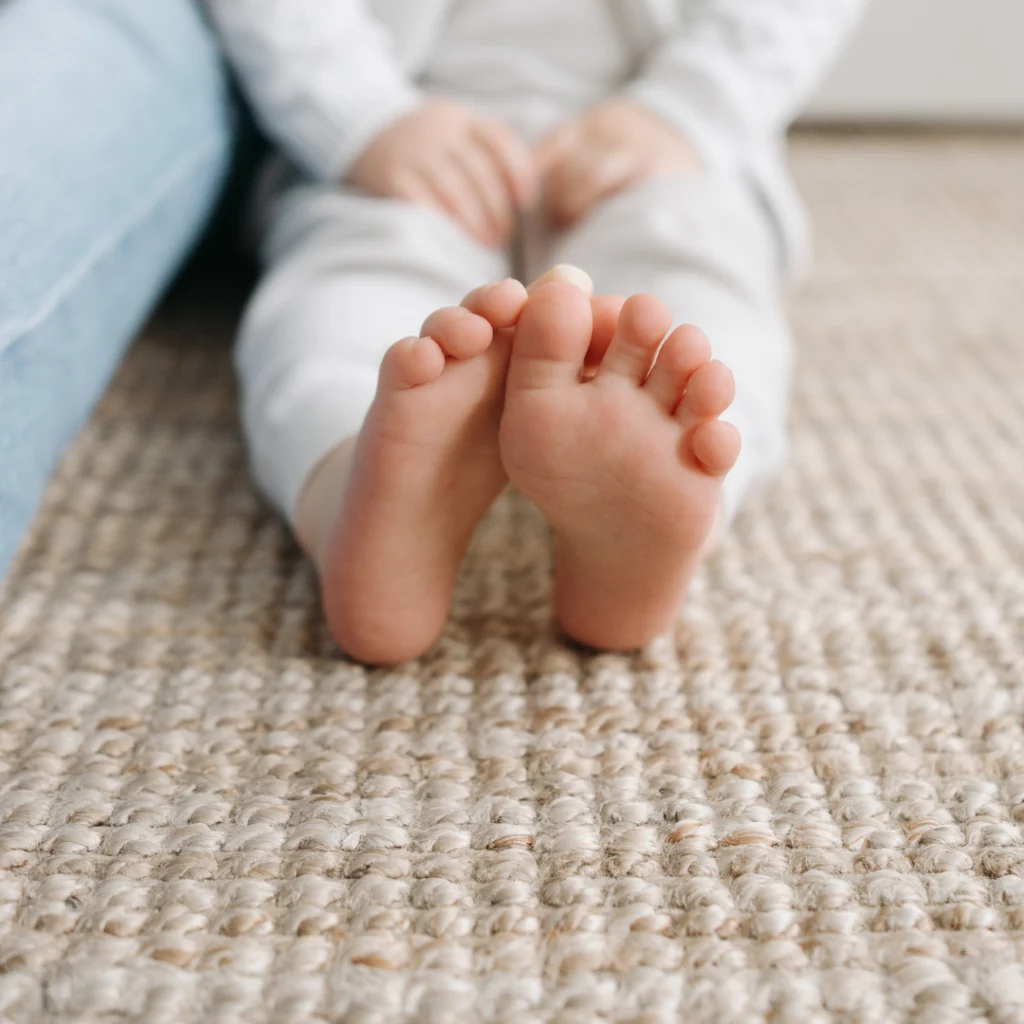
Then, to help differentiate between the origin being from shin or foot – have your little one seated while you gently hold their heel in a neutral position, straighten their knee and look at their foot FROM THE BOTTOM. If toes are still curving inward in this non-weight bearing position, the origin of the in-toeing is usually the foot/metatarsus adductus.
What about out-toeing?
Again – ANYTIME concerns are present, please bring them to your care teams attention to discuss if referral is warranted!
However, consideration of these two areas is often helpful when you see out-toeing in your little one:
- Consider their age first. Most children will naturally outgrow mild out-toeing by 10 years of age as their bones and muscles develop. If there is a new onset of out-toeing as a child nears adolescence, especially if there is pain or limping, discussion with your medical provider is warranted to ensure nothing more serious is the cause.
- Check out those feet! Have your child stand in front of you with their back to you. Take a pencil, lining it up with the big tendon running along the bottom/back of the calf towards the heel. The pencil should *ideally* be completely pointed toward the ceiling vertically. If the pencil is tilted inward toward the other foot, flattened arches may be the culprit and referral to physical therapy may majorly benefit your little one!
Are in-toeing or out-toeing harmful to my child?
It depends on the origin & severity, however most often the presence of mild to moderate in OR out-toeing in young children will self resolve without intervention. In more severe cases there can be pain, limitations in function, balance concerns with increased trips & falls, limping, abnormal wear and tear on joints – though again, these circumstances are less common.
While you should absolutely bring any concerns you have about your child’s development to their care team, many pediatric orthopedists are not concerned about variations in foot/leg alignment during walking until 3+ years of age, often declining to even assess them unless certain characteristics are present in conjunction with the leg alignment – those things often include:
- If leg positioning is persistent and atypical on ONE side ONLY
- If there is a history of concerns around hip development and/or or concerns around hip dysplasia (or a history of being breech in utero)
- If there is ANY pain, limping, or balance concerns present
- If there are developmental delays present or delays in milestone acquisition
How are in-toeing and out-toeing treated?
Most commonly, both in-toeing and out-toeing self correct when mild in presentation as natural developmental changes in strength, bony alignment and overall musculoskeletal system development occur.
If treatment IS deemed necessary, it can vary greatly depending on the severity of the alignment and the origin of the leg positioning. Physical therapy exercises, bracing & orthotics are the most common interventions, with more serious (and less commonly seen) cases requiring potential surgery (like SCFE above!).
Let’s Wrap This Up!
Overall…..both in and out-toeing are not typically a major concern, especially in the first 3-4 months after walking begins, even extending into the first few years of life! Much of resolving those leg positions just come down to development, how our musculoskeletal system changes & grows, and strengthening all of those big important muscles as they learn to roll, sit, crawl & walk!
And if your little one is turning feet out or in – check out the reels below for some fun tips and activities you can incorporate into your day to help!
- Activities For Legs Turning In or Out When Walking
- Functional Single Leg Stance Activities To Add Into Your Day
- More Single Leg Stance Tips To Try
Hope that helps!
Want More?
For developmental questions, tips and guidance related to milestones about tummy time, rolling & sitting, crawling and walking, check out KC’s developmental Masterclasses linked here.

Was this helpful? Save it for later!