October 23, 2024
Best Shoes for Baby Learning to Walk

Some of the links on this page may be affiliate links. That means, I get a small commission if you purchase through this link. However I make it a point to only share items that I truly love, use, or check all my boxes!
A Pediatric Physical Therapists Guide: Everything you need to know for first walkers (& Beyond)
TLDR (too long didn’t read?) We get it! – Skip the read and check out our COMPLETE Shoe Guide.
Looking for Walking Support? We got you covered. Check out our Walking Masterclass: Everything you need to know to get your little one taking those first steps!

When do Babies NEED Shoes?
This is one of the most common questions I get, so let’s start here!
Here’s the thing – barefoot is absolutely best when it comes to foot development and health for the vast majority of children (and adults!) – I’ll talk more about this below.
BUT… the reality is that your child WILL need to start wearing shoes at some point, especially as they become more adventurous explorers and begin to navigate a variety of terrains, and especially terrains & environments that may pose a risk of injuries to their feet.
That being said…I’d bet many of us have experienced putting shoes on our little ones for the first time and they almost instantly channel a puppy with those little snow booties on their feet …
So what characteristics in shoes are best? When and how do we start introducing shoes- so that when our baby really NEEDS them, they’re used to them enough to reap the benefits of protecting those precious little toes?
Let’s talk about it!
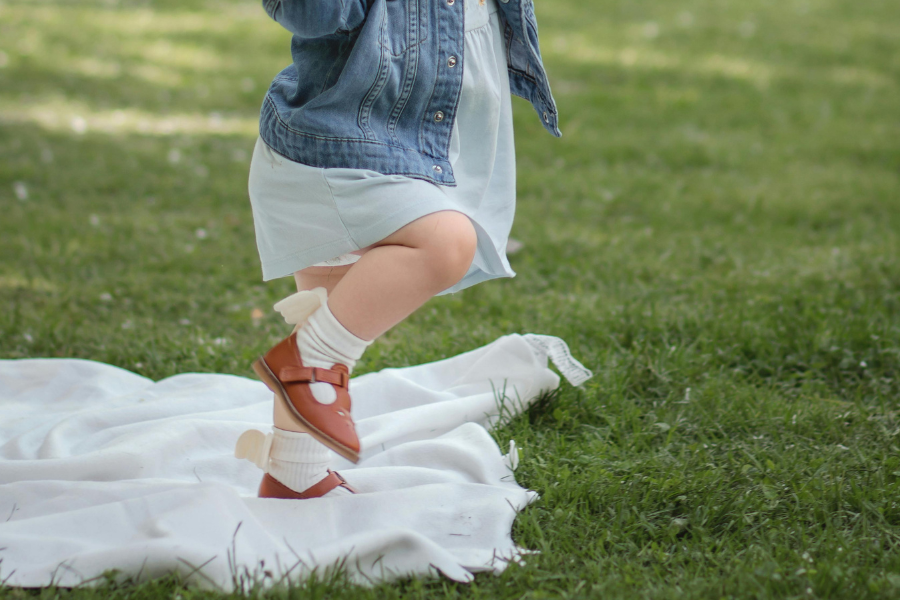
The BENEFITS of Being Barefoot
As mentioned earlier, when it comes to foot health & development, barefoot is absolutely best. But why?
Did you know….at birth our little one’s feet are actually more cartilage than bone? It’s true! In fact – from birth to 5+ years old, children’s feet are constantly growing (around a half size every 3-4 months!), what was cartilage at birth is slowly ossifying (hardening) into the bones of the feet, they transition from being flat footed with fat pads for cushioning to their arches developing as they strengthen, weight bear and gain sensory input. Amazing, right?!
So, back to it- You’ve likely heard it before and I’ll say it again:
Being barefoot provides immense benefits to overall foot development and health, but WHY?
To name just a few benefits, being barefoot provides:
- IMMENSE SENSORY RICK OPPORTUNITIES TO THE FEET
Exposure to different surfaces, especially as little ones are learning to be upright and move against gravity allows our sensory and musculoskeletal system to work together, which in turn helps - INCREASED BODY AWARENESS
The understanding where your body is in space relative to objects around you. - IMPROVED BALANCE & COORDINATION
As the feet splay, muscles strengthen & react to differences in terrain, and little ones learn how to successfully navigate those variations
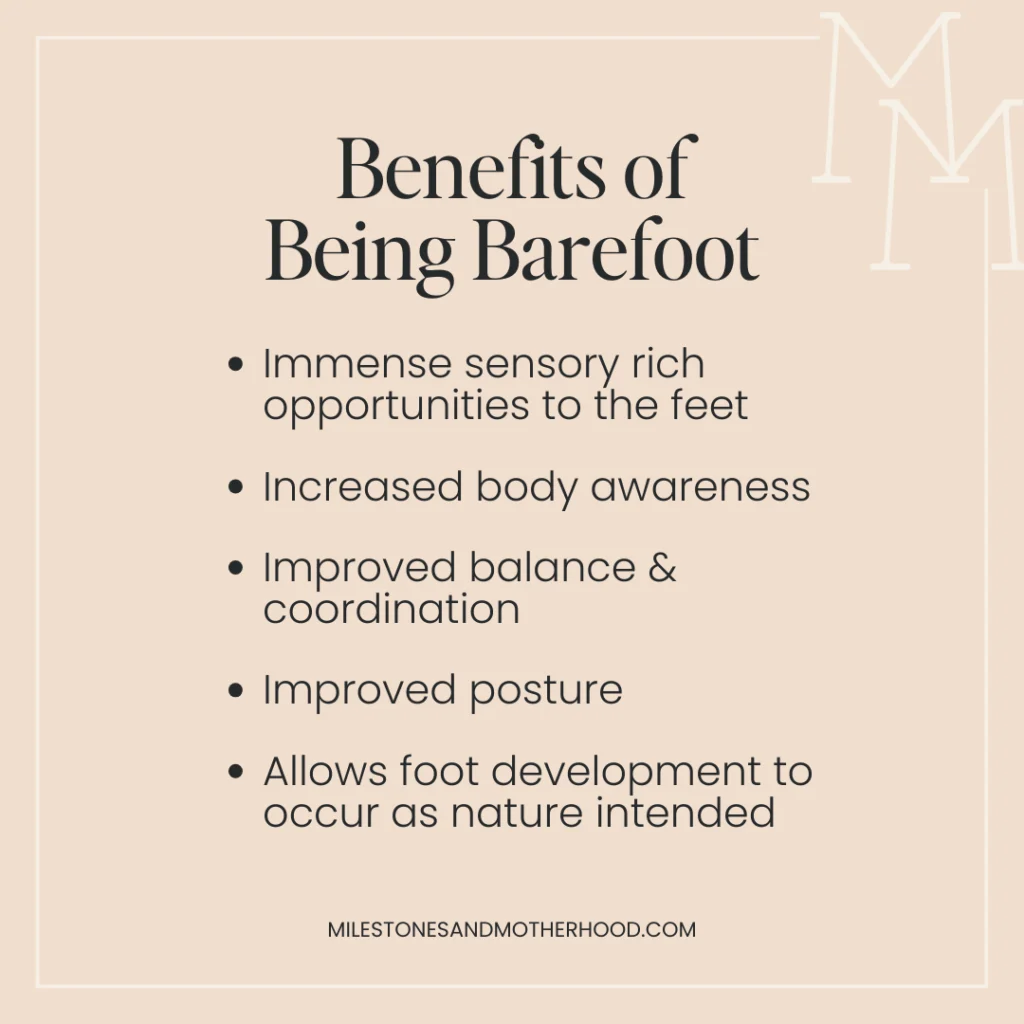
- IMPROVED POSTURE
As the body learns to react to input it’s receiving through the feet - ALLOWS FOOT DEVELOPMENT TO OCCUR AS NATURE INTENDED
As the foot strengthens, the bones & joints of the feet ossify & form what will become the adult foot, and their feet are overall healthy enough to react to all they do to carry us through life forever!
For more on the benefits of barefoot, including some of my favorite Barefoot Shoes (for adults & littles!), check out the Milestones & Motherhood Shoe Guide!

So…we know barefoot is best for most, but what do you look for when it’s time to put shoes on your little one?
Let’s dig in!
What to LOOK for in First Walkers for Baby
If you’ve got a little one on the verge of exploring their world upright, it’s SUCH an exciting time, and the perfect time to start thinking about ideal footwear to support foot development and set them up for a lifetime of foot health!
As a pediatric physical therapist & mom of 3 myself, I know ‘ideals’ aren’t always possible (especially when our littles get an idea of what THEY think is best IYKYK my little croc loving babes) – but when possible, here are the main characteristics of first walker shoes for baby I aim for:
- FOOT SHAPED, WIDE TOE BOX
This is different from ‘wide’ shoes! A foot shaped toe box does not taper at the toes and stays wide from the base of the toes to the tips of the toes. This allows the toes to fan out and splay just like they would when barefoot, allowing the entire foot to develop & strengthen more naturally and without restriction.
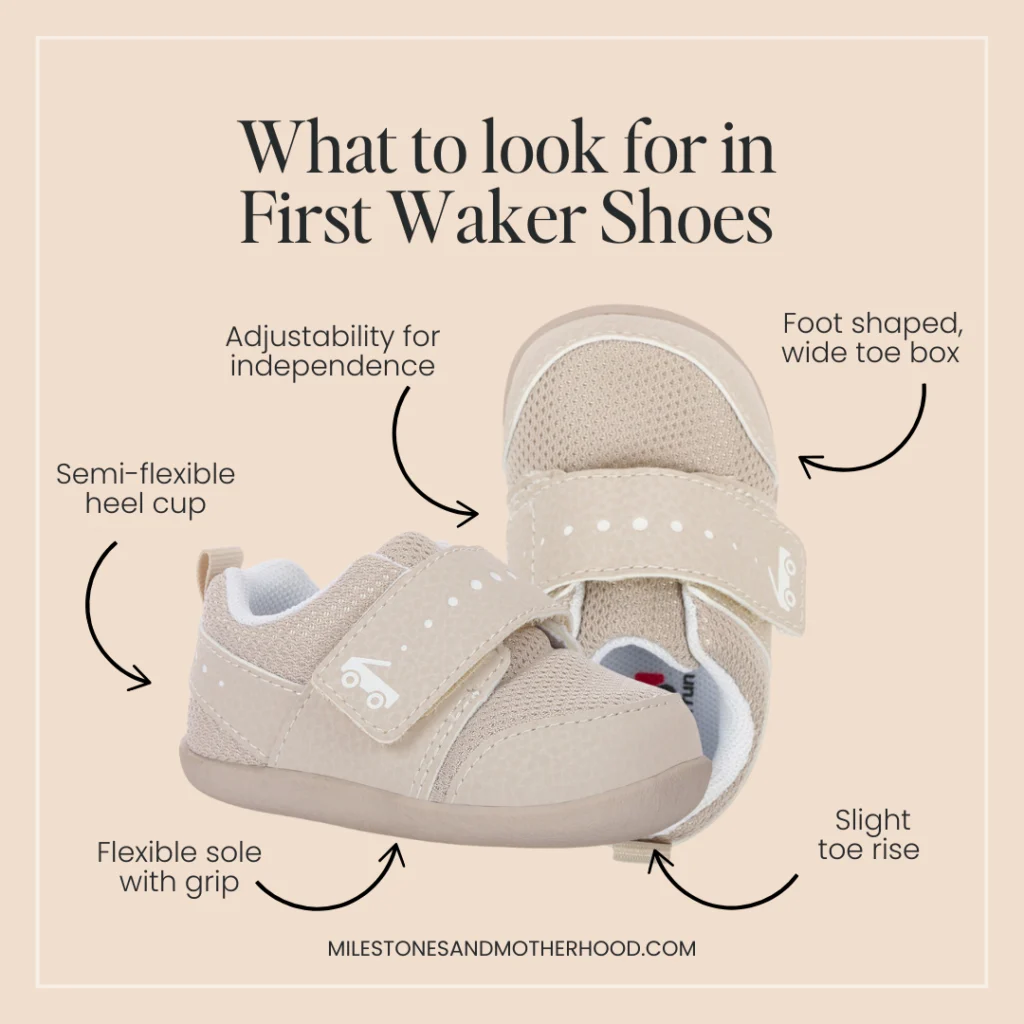
- FLEXIBLE SOLE WITH GRIP
Ideally, we want to be able to fully twist or bend a first walker (and beyond!) shoe completely in half, which allows the foot to move naturally & react appropriately to ground forces. - ADJUSTABILITY FOR INDEPENDENCE
Velcro straps on first walkers are amazing for adjustability, getting shoes on/off with those chubby little feet, and encouraging independence. - SEMI-FLEXIBLE HEEL CUP
This provides support while still allowing those developing ankle muscles to work - SLIGHT TOE RISEWhen placing the shoe flat on the floor, the toe part should go *slightly* upward, which assists in the toe off pattern seen in mature walking
I Consider a ‘First Walker’ Shoe to be ideal as a Child’s FIRST Shoe When Walking.
Typically, children are ready to transition away from shoes labeled specifically as ‘first walkers’ within 2-3 months of being fully proficient walkers and/or once they outgrow the first pair!
What to LOOK for Beyond First Walkers
When transitioning beyond first walkers, the biggest difference in shoe characteristics I am for is:
- A SLIGHTLY MORE SUPPORTIVE HEEL CUP
These support more advanced gross motor activities like running & changing directions.
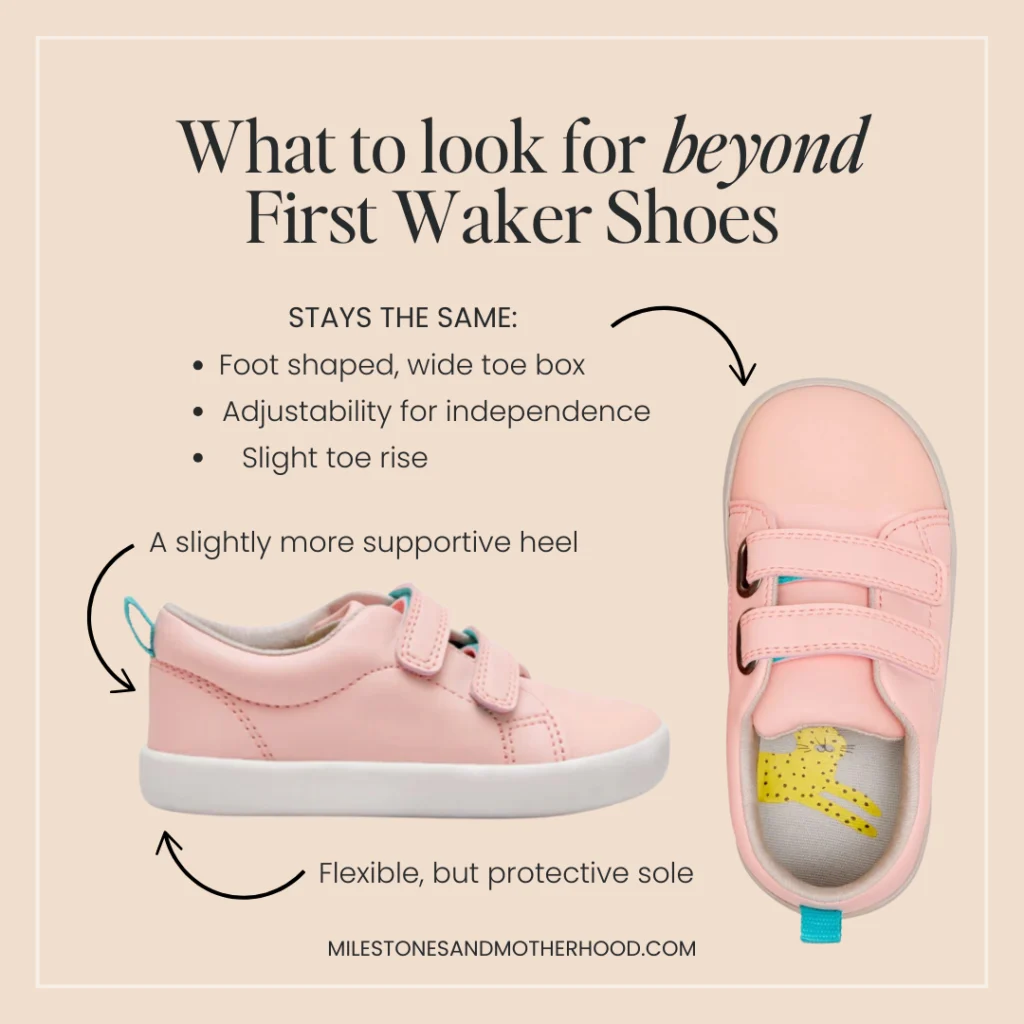
- FLEXIBLE, BUT PROTECTIVE SOLE
The surfaces they are walking on will become more varied and potentially hazardous. With that more protective sole, you may lose SOME flexibility, but most shoes are still bendable!
For a visual overview of these characteristics- check out my Shoes for New Walkers post on Instagram!
How Do I Buy Shoes Ahead of Time For My Child?
With our little one’s feet quite literally growing like weeds in the first years of their life, it can be SO helpful to plan ahead & stock up on shoes during sales, but can you estimate shoe size and growth? If so…how?
While it’s definitely NOT an exact science, this is the method I’ve used for my own children for the last 7 years, and for countless other families! Generally speaking, you can roughly estimate about a HALF SIZE of growth every 2-3 months in the first 3 years of life. At that time, it does generally tend to slow a bit, becoming closer to about a half size of growth every 3-4 months until 5-6 years of age.
So, when buying ahead, I consider how rapidly they are currently moving through sizes and then I also recommend taking seasons into account! For example, if you’re looking for winter boots, take into account that socks will be a little thicker, in which case going up a half size wouldn’t hurt.
Want tips on how to measure your child’s foot for their shoes? See my post on Instagram here!

- Boots & Booties
- Pre-walker Shoes
- First Walker Shoes
- Sneakers
- Barefoot Shoes
- Shoes for Small Feet
- Shoes for Wide & Chubby Feet
- Shoes for Narrow Feet
- Shoes for Toe Walking & Hypermobility
- Shoes for Pronation
- Orthotic Friendly Shoes
- Cleats
- Snow Boots
- Rain Boots
- Water Shoes
- Non-Slip Socks & MORE
Does your little one need SUPPORT taking those first independent steps?
Check out my Mastering Walking Course where you’ll find answers to these common walking hurdles:
- “My Baby Pulls to Stand but Won’t Walk.”
- “My Baby Will Only Walk Holding My Hands.”
- “How to Get my Baby to Walk?”
- “I Know My Baby Can Walk, But They Won’t Let Go! “
& EVERYTHING you need to know to build the necessary skills to get your little one taking those precious FIRST steps!